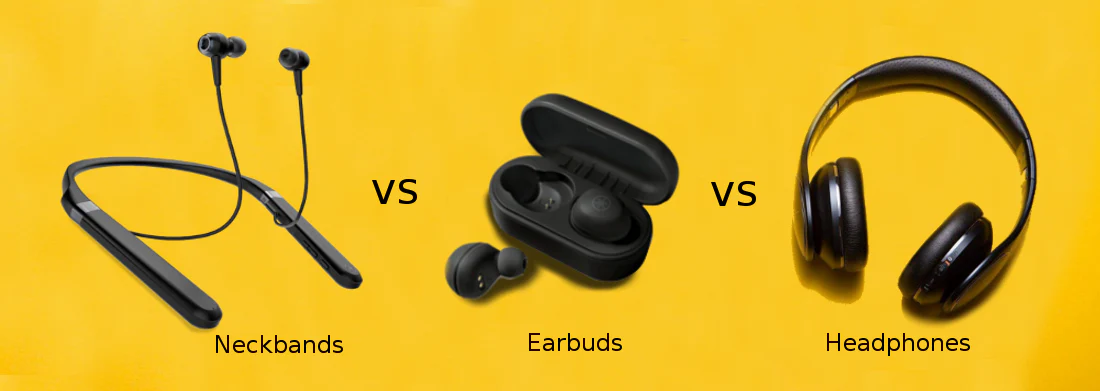
When shopping for portable audio devices, many buyers find themselves deciding between true wireless earbuds and neckband earphones. Both options remove the inconvenience of traditional wired earphones, but they offer different strengths. Choosing the right one depends less on trends and more on how the device will actually be used. This comparison looks at comfort, portability, battery life, sound quality, convenience, call performance, and value to help everyday users decide which type makes more sense for them.
The most obvious difference is design. True wireless earbuds are completely cable-free. They usually come in a compact charging case and are designed for maximum portability. Neckband earphones, on the other hand, connect the left and right earpieces with a cable and place the battery and controls within a band that rests around the neck. Each design has its own appeal. Wireless earbuds feel cleaner and more modern, while neckbands often feel more secure and easier to keep track of.
Portability is where true wireless earbuds have a clear advantage. Their small case fits easily in a pocket, making them convenient for commuting, travel, and general daily carry. Neckbands are portable too, but they are less compact. They are often worn around the neck when not in use, which some people find convenient and others find awkward. If the main priority is carrying something discreetly and neatly, wireless earbuds usually win.
Comfort depends on both product quality and personal preference. Wireless earbuds are lighter and feel less noticeable once properly fitted. This can make them ideal for short and medium listening sessions. However, because they sit independently in each ear, some users worry about them loosening or falling out. Neckbands can feel more secure because the wire and band reduce the chance of losing an earpiece. For people who move around a lot or remove and reinsert their earphones frequently, neckbands may feel more practical.
Battery life is a major point of difference. Neckband earphones often offer longer continuous playback on a single charge because they have more space for larger batteries. This makes them especially useful for long workdays, travel, or extended listening. Wireless earbuds rely on both the earbuds and the charging case. While the total battery can still be good, the earbuds themselves usually need to return to the case after several hours. For users who prefer uninterrupted long sessions, neckbands often have the advantage.
Sound quality varies widely within both categories, but there are some general patterns. Wireless earbuds are designed for convenience, and many mainstream models offer bass-heavy tuning that suits popular music and casual listening. Neckband earphones can also sound very good, and some users feel they deliver more consistent audio for the price. The difference today is smaller than it used to be, but value-focused buyers may still find strong sound quality more easily among neckbands.
Call quality depends on microphone placement, noise handling, and software processing. Wireless earbuds often market themselves heavily on call performance because they are commonly used for work and phone calls. Many modern models do a decent job in quiet environments. Neckbands can also perform well, though the exact result depends on where the microphone sits on the cable. In either category, premium models tend to handle noisy environments better, but for ordinary indoor calls, both can work well.
Convenience in daily use is where personal habits matter most. Wireless earbuds are excellent for people who want something quick, modern, and minimal. Taking them out of a case and connecting instantly feels easy and satisfying. But the small size also makes them easier to misplace. Neckbands are less likely to disappear because they stay around the neck. That makes them appealing to users who are constantly taking their earphones in and out during the day, such as office workers or students.
Exercise and movement create another difference. Wireless earbuds are often marketed for workouts because they are cable-free and feel less restrictive. However, fit is critical. If they do not fit well, they may feel insecure. Neckbands can be better for walking, commuting, and lighter movement because they are harder to lose, though the wire may be less appealing during intense exercise. People who want complete freedom may prefer earbuds, while people who prioritize security may choose neckbands.
Durability and risk of loss should not be ignored. Wireless earbuds are compact and convenient, but each individual earpiece can be lost separately. The charging case can also be misplaced. Neckbands are easier to keep track of simply because they are larger and remain attached together. Buyers who know they tend to misplace small gadgets may want to think carefully about this.
In terms of value, neckband earphones often remain excellent options for buyers who want long battery life and dependable everyday use at lower prices. Wireless earbuds can justify their popularity through portability, modern design, and convenience, but they are not automatically better for every person. They are better for some lifestyles, not all.
Related: Wireless Earbuds Review: Comfortable Sound for Everyday Listening
The final decision depends on priorities. Choose true wireless earbuds if you want the most modern design, pocket-friendly portability, and complete freedom from cables. Choose neckband earphones if you want longer battery life, easier handling, better security against loss, and often stronger value for money. Neither category is universally better. The right choice depends on how and where you actually listen.
About The Author